European SafeBorders Project Nearing Completion
SafeBorders is an EU-funded project that aims to address the issue of child trafficking by enhancing the capacities of judicial authorities and frontline professionals. The project focuses on prevention, protection and prosecution to ensure that children in vulnerable situations are protected from exploitation. It focuses on identifying risk patterns and vulnerabilities, mapping protection and reintegration actors, analysing legal and procedural frameworks, and strengthening transnational cooperation to detect criminal networks.
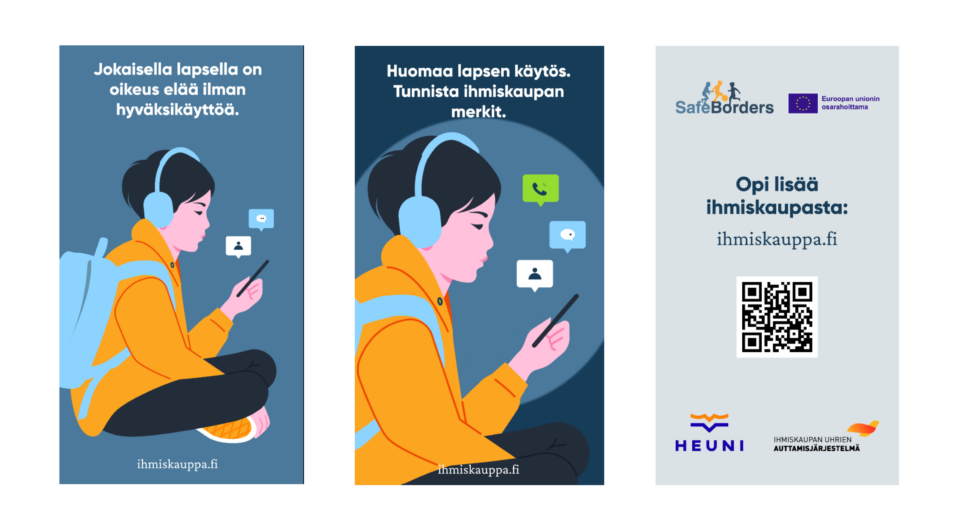
This week, passengers travelling on the Helsinki metro may have seen an anti-trafficking campaign video at several metro stations. The video is aimed at children and young people, as well as those close to them, and is part of the SafeBorders project. The National Assistance System for Victims of Human Trafficking is participating in the campaign.
A handbook offering practical tools
Developed as part of the EU-funded SafeBorders project, the handbook supports coordinated, multidisciplinary efforts to combat trafficking in children and young people. It provides a structured, comparative overview of the key challenges and promising practices identified in anti-trafficking work involving children and young people in eight European countries.
Organised around the Four Ps–prevention, identification, protection, prosecution, and partnership–building–it highlights common gaps, promising practices, and practical tools, while offering evidence-based recommendations to strengthen ju dicial expertise, frontline response, and cross–border cooperation. Developed under the SafeBorders project, funded by the European Union, the Handbook serves as a strategic reference framework to support coordinated, multi-stakeholder action against child trafficking.
The handbook brings together findings from mapping exercises and contextual analyses, legal and institutional reviews, and extensive stakeholder consultations. These examine the forms and routes of trafficking, victims’ vulnerabilities, modus operandi and national systems across the participating countries.
The Handbook is available here:
A Handbook on Challenges and Best Practices in Combating Child Trafficking
The project is implemented by a consortium from eight EU member states: the Centre for European Constitutional Law (CECL, Greece), coordinator of the project, the Ministry of Migration and Asylum of the Hellenic Republic (MoMA, Greece), Cesie Ente Del Terzo Settore (CESIE, Italy), the Center for the Study of Democracy (CSD, Bulgaria), Missing Children Europe (MCE, Belgium), Asociatia Pentru Dezvoltarea Practicilor Alternative de Reintegrare si Educatie (ADPARE, Romania), Fundacja Vela Organizacja Humanitarna na Rzecz Ochrony i Edukacji (VELA, Poland), Qualify Just – IT Solutions and Consulting SA (IPS_Innovative Prison Systems, Portugal), The European Institute for Crime Prevention and Control, affiliated with the United Nations (HEUNI, Finland) and Associacao Saude em Portugues (SAUDE, Portugal).
Additional information on the topic:
HEUNI Report series № 114. Children at risk. Trafficking and Exploitation in Finland | Heuni